Piteå Museum: Cycles of Unease—Rudolf Gowenius & Andjeas Pestov Ejiksson
15 October 2026—5 September 2027
Exhibitions
Piteå museum
Cycles of Unease, opening at Piteå Museum on October 15, 2026, traces the life and work of the artist Rudolf Gowenius (1896–1960). Born in Öjebyn, Gowenius studied in Stockholm and later worked as an artist in Paris, among other places. The exhibition brings together paintings, sketches, prints, and archival material tracing his singular artistic trajectory, alongside a new work by Andjeas Pestov Ejiksson.
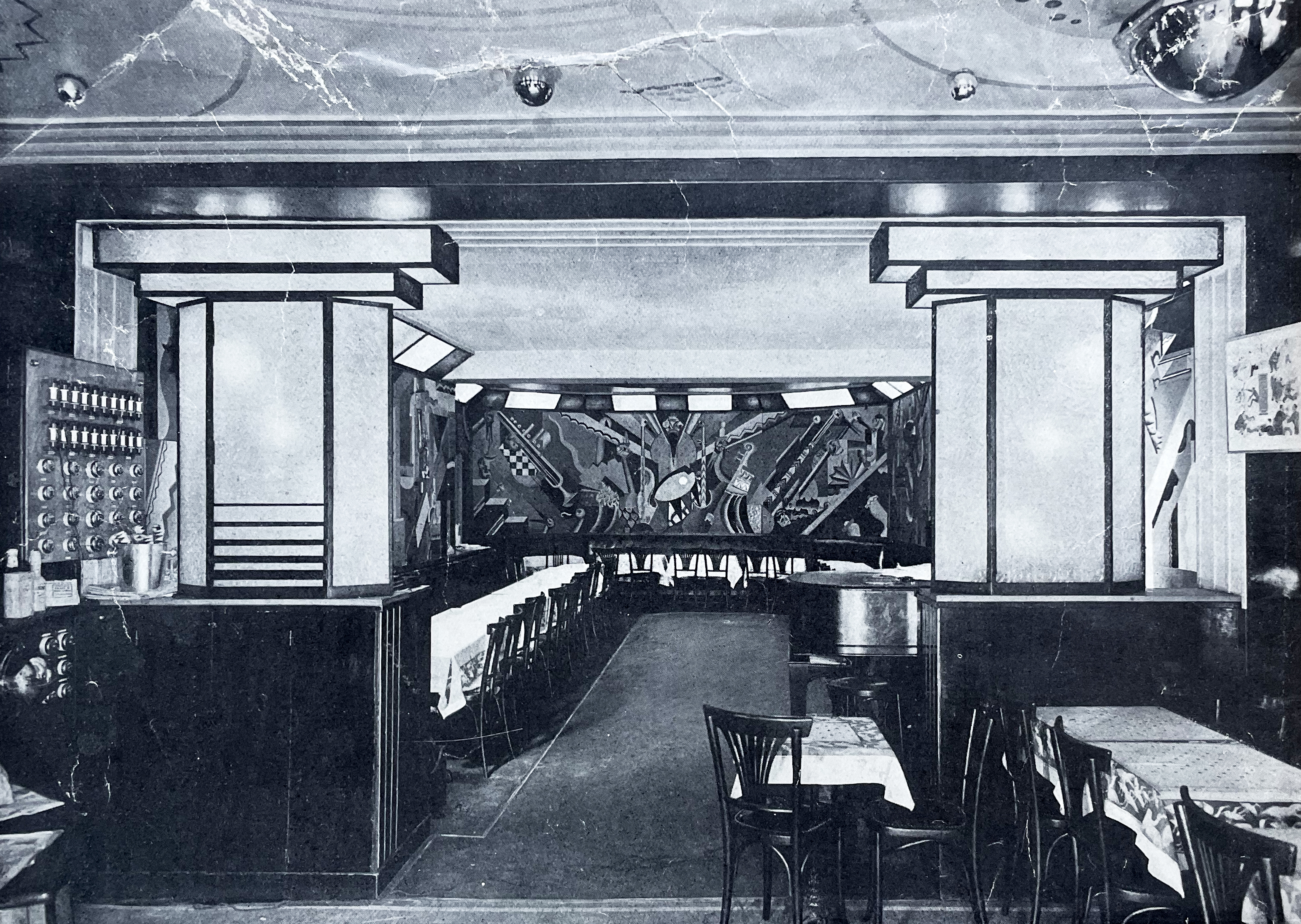
Gowenius’s practice opens onto a multifaceted account of modernity. He moved between spheres that art history has often kept separate: art and decoration, churches and entertainment venues, advertising and architecture, craft and technological innovation. He created murals for the Paris bars La Cigogne and Bar O.K., developed a technique for painting on velvet, and painted frescoes in churches in both Sweden and France, among other things. His images and stories connect widely divergent environments and social worlds: from financier Ivar Kreuger’s Paris apartment and the jazz clubs of the metropolis to street life in Marrakesh, Sicilian miners, and representations of Norrbotten as a landscape of myth, nature, and natural resources.
Gowenius worked during a period of profound upheaval: war, economic crises, urbanization, the rise of mass media, and the persistence of colonial rule. Yet these decades were also marked by strong faith in progress, social reform, and the possibility of creating new forms of collective life—convictions that could also take destructive forms, as in the ascendancy of radical nationalism. Optimism and uncertainty existed side by side.
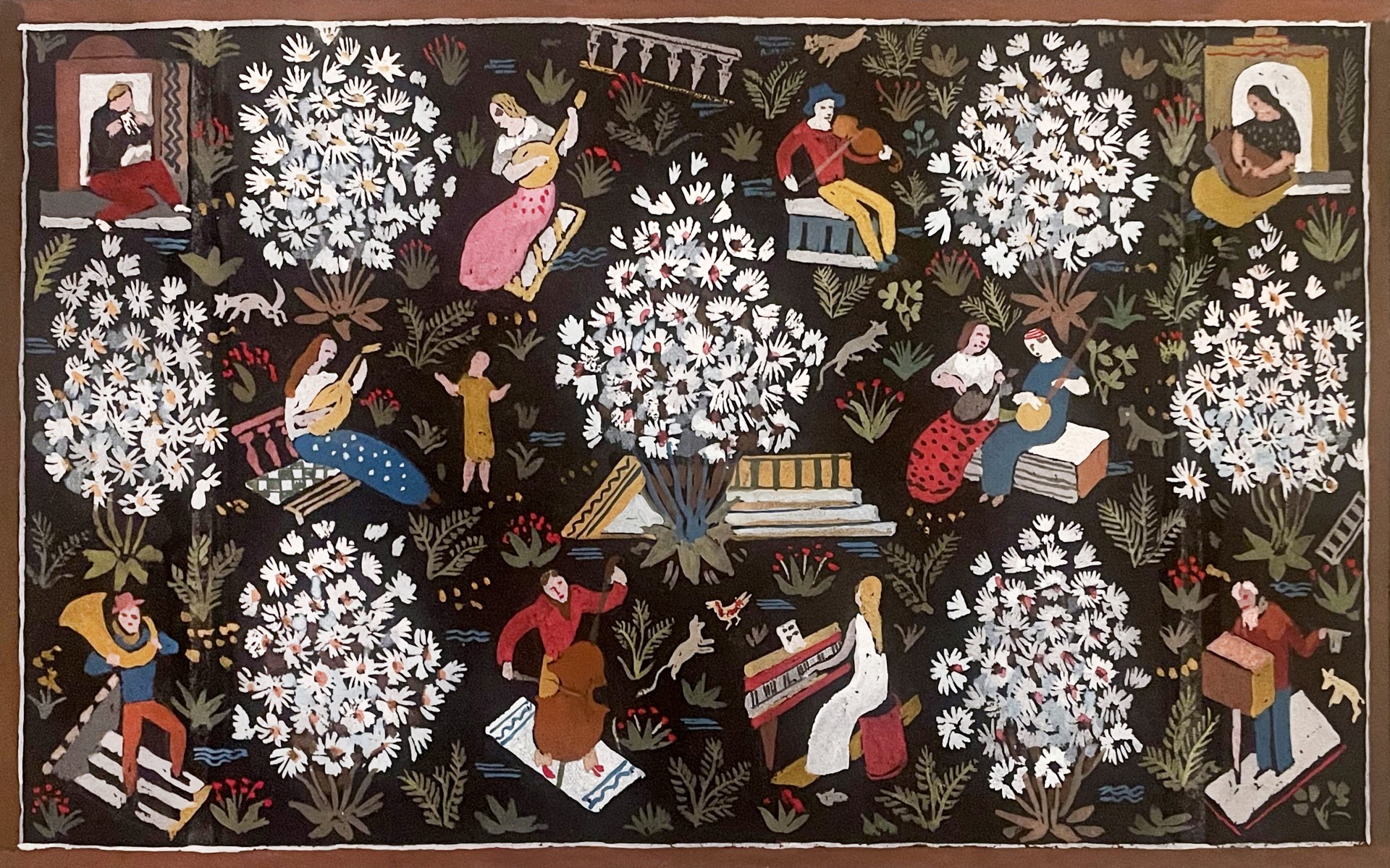
In Gowenius’s work, events both large and small converge. One notable example is the velvet painting he and his partner Maya Gowenius completed in the spring of 1932 for Kreuger’s private music room. Kreuger’s business empire had come to embody both the ambitions and the vulnerabilities of the period: faith in modern finance and technological progress on the one hand, and growing instability on the other. As the work was about to be delivered, Kreuger was found dead, and the painting was thereby drawn into the economic—and, for many people, deeply personal—crisis that followed the collapse of the Kreuger empire.
In his letters to his mother, written throughout his adult life, Gowenius emerges as a man trying to hold together love, family, finances, and artistic ambition in times of uncertainty. Yet the letters also convey a persistent sense of possibility, even when circumstances are precarious. The letters lend his artistic production a particular charge: behind the ornamentation, humor, and densely populated narratives lie both hope, the fragility of existence, and an almost compulsive need to keep working.
The exhibition’s title Cycles of Unease refers to modernity’s recurring tension between uncertainty and optimism, suspended between crisis and dreams of progress, community, and spiritual renewal. Here, unease is not understood solely as an individual feeling, but as something that arises in the relationship between people and the economic, political, and technological systems in which they live. The idea of a cycle therefore refers to fluctuation in a broad sense: to the shifting configurations of ideas, images, people, values, and circumstances that shape a historical moment. Art becomes a site where such connections can be traced and where unease emerges as an underlying historical current.
The exhibition is structured around five clusters of images and fragments of Gowenius’s work, together with an audiovisual installation by Andjeas Pestov Ejiksson, who has also curated the exhibition. The installation shares the exhibition’s title and consists of ten channels of sound and image. Created in collaboration with musician and composer Andreas Westerdahl, it is a musical interpretation of the painting that Rudolf Gowenius was due to deliver to Ivar Kreuger in the spring of 1932. The painting later disappeared from view but survives in a black-and-white photograph and a small color study.
The exhibition is developed in dialogue with Vera Gowenius, the artist’s daughter, and produced by Kin Museum of Contemporary Art, where it will also be presented in the fall of 2027.
Image 1: Rudolf Gowenius. Sketch for a velvet painting commissioned by financier Ivar Kreuger for his music room, 1931.
Image 2: Interior with mural at the La Cigogne nightclub, Montparnasse, Paris, 1931. Photographer unknown.
Image 3: Rudolf Gowenius beside the advertising column he created for Svenskt Papper for the 1937 Paris International Exposition. Photographer unknown.
Image 4: Photograph taken during the painting of a fresco at Église Sainte-Anne de Tavaux, Tavaux, 1938. Photographer unknown.